
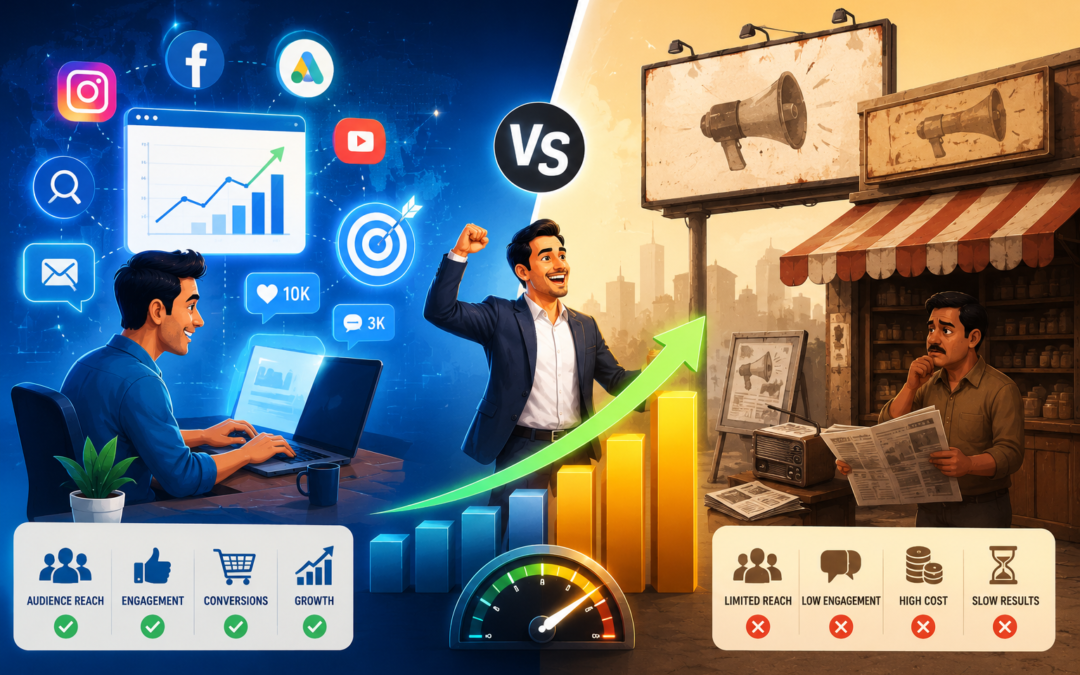
Featured Snippet Answer: Digital marketing grows businesses faster than traditional marketing in most cases. It offers real-time results, lower costs, precise audience targeting, and measurable data. Traditional marketing builds brand awareness through print, TV, and radio but lacks the flexibility and trackability of digital channels. For most businesses today, a digital-first strategy delivers faster and more affordable growth.
Contents
- 1 Introduction: The Marketing Battle Every Business Owner Faces
- 2 What Is Traditional Marketing?
- 3 What Is Digital Marketing?
- 4 Digital Marketing vs Traditional Marketing: A Direct Comparison
- 5 Which One Is Better for Your Business?
- 6 The Role of a Professional in Making This Decision
- 7 Why Businesses in Hubli Are Going Digital
- 8 Common Myths About Digital Marketing
- 9 Key Digital Marketing Metrics Every Business Owner Should Know
- 10 How to Start Transitioning from Traditional to Digital Marketing
- 11 Frequently Asked Questions
- 12 Conclusion: The Verdict
- 13 Ready to Grow Your Business with Smart Digital Marketing?
Introduction: The Marketing Battle Every Business Owner Faces
Every business owner faces the same question at some point. Should I spend money on a newspaper ad or run a Facebook campaign? Should I print 5,000 flyers or create a Google ad that reaches 50,000 people?
This question is not just about money. It is about where your customers are, how fast you want to grow, and how clearly you want to measure your results.
Marketing has changed dramatically over the last decade. The rise of smartphones, social media, and search engines has shifted the way people discover and buy products. But traditional marketing has not disappeared. Billboards still exist. TV commercials still run. Newspapers still print.
So which one is actually better for your business?
This article breaks down both marketing types clearly, honestly, and without fluff. By the end, you will know exactly which strategy makes more sense for your business goals.
If you are a business owner looking for the best digital marketing freelancer in Hubli to guide your marketing decisions, this article will also show you what to look for and why professional help matters.
What Is Traditional Marketing?
Traditional marketing refers to any promotional method that existed before the internet. It includes physical and broadcast media.
Common Types of Traditional Marketing
Print Advertising: Newspaper ads, magazine ads, brochures, and flyers. These are tangible materials people can hold and read.
Broadcast Advertising: TV commercials and radio spots. These reach large audiences simultaneously.
Outdoor Advertising: Billboards, banners, posters, and hoardings. These work well for location-based visibility.
Direct Mail: Physical letters, catalogs, and postcards sent to a list of addresses.
Event Marketing: Trade shows, exhibitions, sponsorships, and in-person product demos.
Traditional marketing has been the foundation of brand building for over a century. Many large brands like Coca-Cola, Amul, and Maruti built their identities through traditional channels. These methods carry a sense of credibility and permanence that some audiences still respond to deeply.
Strengths of Traditional Marketing
Traditional marketing reaches people who are not active online. It works well for audiences aged 50 and above who still consume TV and newspapers regularly. A full-page ad in a local newspaper carries authority that a social media post sometimes cannot replicate.
It also creates offline visibility. A billboard near a busy road in Hubli can build local brand recognition effectively. People notice physical ads in ways that digital ads can be ignored or skipped.
Traditional marketing also carries an element of trust. A printed brochure feels more permanent than a website popup. People associate print with credibility.
Weaknesses of Traditional Marketing
The biggest challenge with traditional marketing is measurement. When you place a newspaper ad, you cannot know exactly how many people read it, how many called you because of it, or how many purchased your product as a result.
It is also expensive. A 30-second TV commercial or a double-page magazine spread costs far more than most digital campaigns with equal reach.
Traditional marketing lacks flexibility. Once a billboard goes up or a newspaper ad prints, you cannot change it. If your offer changes or your product evolves, you are stuck with outdated communication.
Targeting is broad and imprecise. You cannot show a traditional ad only to women aged 25 to 35 who live in Hubli and are interested in skincare. You reach everyone and hope the right people notice.
What Is Digital Marketing?
Digital marketing includes any promotional activity carried out through the internet or digital devices.
Common Types of Digital Marketing
Search Engine Optimization (SEO): Getting your website to appear at the top of Google search results without paying for ads. SEO is a long-term strategy that drives organic, free traffic to your site.
Search Engine Marketing (SEM): Paid ads that appear on Google when people search for specific keywords. You pay only when someone clicks your ad.
Social Media Marketing: Promoting your business on platforms like Instagram, Facebook, LinkedIn, and YouTube. This includes both organic posts and paid advertisements.
Content Marketing: Creating blogs, videos, podcasts, and infographics that educate and attract your target audience.
Email Marketing: Sending targeted messages to a list of subscribers to nurture relationships and drive sales.
Influencer Marketing: Partnering with creators who have large, engaged followings to promote your product or service.
Affiliate Marketing: Paying partners a commission for driving sales or traffic to your business.
Strengths of Digital Marketing
Digital marketing is measurable. Every click, every impression, every sale, and every lead can be tracked precisely. You know exactly what is working and what is not.
It is cost-effective. A small business in Hubli can run a well-targeted Instagram ad campaign for Rs. 500 per day and reach thousands of potential customers in their city.
Digital marketing is fast. You can launch a campaign today and see results within 24 hours. You can pause, edit, or scale your campaign at any time.
Targeting is extremely precise. You can choose your audience based on location, age, gender, interests, income level, and even the type of phone they use.
Digital marketing also enables two-way communication. Customers can comment on your posts, ask questions, share your content, and give feedback. This builds genuine relationships between brands and their audiences.
Digital Marketing vs Traditional Marketing: A Direct Comparison
Let us compare both approaches across the factors that matter most to a business owner.
Cost
Traditional marketing is significantly more expensive. A half-page newspaper ad in a regional paper can cost Rs. 20,000 to Rs. 1,00,000 depending on the publication. A 10-second radio spot may cost Rs. 5,000 to Rs. 30,000 per broadcast.
Digital marketing allows you to start with budgets as low as Rs. 200 per day on social media. You can scale up or down based on results. Small businesses can compete with large ones without spending lakhs.
Winner: Digital Marketing
Reach
Traditional marketing can reach local and national audiences through TV and radio. However, it is not personalized. You reach everyone in that geographic area regardless of whether they are your target customer.
Digital marketing can reach local, national, and global audiences simultaneously. More importantly, it reaches the right people at the right time.
Winner: Digital Marketing for targeted reach, Traditional for mass local awareness
Measurement and Analytics
Traditional marketing offers limited measurement. You may survey customers to ask how they heard of you. You may track a dedicated phone number in a print ad. But the data is incomplete and delayed.
Digital marketing gives you real-time analytics. Google Analytics, Meta Business Suite, and other platforms show you exactly how many people saw your ad, clicked it, visited your website, and made a purchase.
Winner: Digital Marketing
Credibility and Trust
Some audiences still trust print and TV more than digital ads. A feature in a reputable newspaper or a mention on a regional news channel carries authority.
However, strong SEO rankings, genuine customer reviews, and consistent social media presence are now equally trusted by younger audiences.
Winner: Traditional for older audiences, Digital for younger and urban audiences
Speed
Traditional marketing has long lead times. Planning a TV commercial, getting it produced, booking a slot, and airing it takes weeks or months.
Digital marketing is almost instant. You can write an ad, set a budget, and launch it within minutes.
Winner: Digital Marketing
Flexibility
Once a traditional campaign launches, it is difficult to change. Printed materials are static. A TV commercial requires expensive reshooting to update.
Digital campaigns can be edited, paused, or completely changed in real time. If an ad is not performing, you can test a new version immediately.
Winner: Digital Marketing
Longevity
A well-placed billboard may stay up for months and create continuous brand impressions. A high-ranking blog article or YouTube video can generate traffic for years.
Digital content compounds over time. A blog post you write today may rank on Google and bring customers to your business five years from now.
Winner: Both, in different ways
Which One Is Better for Your Business?
The answer depends on several factors: your industry, your audience, your budget, and your goals.
When Traditional Marketing Makes More Sense
Traditional marketing works better in these situations:
Your target audience is 50 years or older and not highly active online. If you are running a pharmacy, a religious goods store, or a senior care facility, your audience may respond better to newspaper ads or radio spots.
Your business is highly local and offline. A small roadside restaurant or a local hardware shop may benefit from a banner or pamphlet distribution in the neighborhood.
You want to create broad brand awareness in a specific geography. A billboard near a busy road or a sponsored local event can make your brand visible to thousands of passersby.
When Digital Marketing Makes More Sense
Digital marketing works better in these situations:
Your target audience is active on social media or uses Google to find products and services. Most people today search online before making a purchase decision.
You need a limited budget to deliver maximum results. Digital marketing allows precise allocation of money where it actually converts.
You want to scale your business beyond your local area. Digital marketing removes geographic barriers and allows you to sell to customers across cities or countries.
You want clear data and accountability. Digital marketing shows you exactly where your money is going and what returns it generates.
The Smartest Choice: A Blended Strategy
For most businesses, the ideal approach combines both. Use digital marketing as your primary growth engine and layer traditional marketing on top for offline visibility and local credibility.
For example, a restaurant in Hubli might run Instagram ads targeting food lovers within a 5-kilometer radius, maintain an active Google Business Profile, and simultaneously hand out flyers near colleges and offices.
This blended strategy gives you the precision of digital and the physical presence of traditional.
The Role of a Professional in Making This Decision
Many business owners attempt digital marketing on their own and quickly get overwhelmed. The platforms change constantly. Algorithms update. What worked six months ago may not work today.
Working with a qualified digital marketing professional can save you time, money, and frustration. A professional will audit your business, understand your goals, identify your ideal audience, and create a strategy that uses the right channels in the right combination.
If you are searching for the best digital marketing freelancer in Hubli, you want someone who understands both the digital landscape and the local market. Local knowledge matters. A freelancer who understands Hubli’s consumer behavior, local competition, and regional platforms will build strategies that resonate more deeply than a generic national agency.
Why Businesses in Hubli Are Going Digital
Hubli is one of Karnataka’s fastest-growing commercial cities. With a strong entrepreneurial culture, a growing startup ecosystem, and increasing internet penetration, businesses in Hubli are rapidly adopting digital strategies.
Local businesses, educational institutes, healthcare providers, real estate developers, and retail shops are all investing in SEO, social media, and Google Ads.
The shift is driven by necessity. Customers in Hubli now use Google to find restaurants, coaches, doctors, plumbers, and retailers. If your business is not visible online, you are invisible to a large portion of your potential market.
This is exactly why many Hubli businesses are actively looking for the best digital marketing freelancer in Hubli to establish their online presence and compete effectively.
Common Myths About Digital Marketing
Myth 1: Digital marketing is only for big businesses. Reality: Digital marketing is actually more beneficial for small businesses because it levels the playing field. A well-targeted Facebook ad from a small boutique can outperform a large mall’s generic campaign.
Myth 2: Social media likes equal sales. Reality: Likes and follows are vanity metrics. What matters is conversion: how many people clicked, inquired, or bought. A professional focuses on conversion-driven strategy, not just engagement.
Myth 3: SEO is a one-time task. Reality: SEO is an ongoing process. Search algorithms update regularly. Consistent content creation, link building, and technical optimization are required to maintain and improve rankings.
Myth 4: Traditional marketing is dead. Reality: Traditional marketing is not dead. It is simply less efficient for most businesses compared to digital. In specific contexts, especially for older audiences and offline-heavy industries, it still delivers value.
Myth 5: Digital marketing gives instant results. Reality: Paid ads can deliver results quickly, but organic strategies like SEO and content marketing take time to build momentum. Patience and consistency are essential.
Key Digital Marketing Metrics Every Business Owner Should Know
Understanding these terms helps you have informed conversations with your marketing professional.
Impressions: The number of times your ad or content was displayed to someone.
Click-Through Rate (CTR): The percentage of people who clicked your ad after seeing it. A higher CTR generally means your ad is relevant and compelling.
Conversion Rate: The percentage of visitors who completed a desired action, such as filling out a form, making a call, or placing an order.
Return on Ad Spend (ROAS): How much revenue you earned for every rupee spent on advertising. A ROAS of 4 means you earned Rs. 4 for every Rs. 1 spent.
Cost Per Lead (CPL): How much you spent to acquire one potential customer inquiry.
Organic Traffic: Visitors who found your website through search engines without clicking on a paid ad.
These metrics allow you to evaluate whether your marketing investment is generating real business value.
How to Start Transitioning from Traditional to Digital Marketing
If you have been relying on traditional marketing and want to transition, here is a simple starting roadmap:
Step 1: Set Up Your Digital Foundation Create a professional website, claim your Google Business Profile, and establish social media accounts on platforms where your audience spends time.
Step 2: Define Your Target Audience Know who your customer is. Define their age, location, interests, online behavior, and the problems your product or service solves for them.
Step 3: Start with Local SEO Optimize your Google Business Profile with accurate information, photos, and regular updates. Encourage satisfied customers to leave Google reviews. This is the fastest way to gain local online visibility.
Step 4: Run Small Paid Campaigns Start with a small budget on Google Ads or Meta Ads. Test different messages and audiences. Analyze results and scale what works.
Step 5: Create Consistent Content Publish blogs, videos, or social media posts that educate and entertain your audience. Consistency builds trust and improves search rankings over time.
Step 6: Work With a Professional At some point, the complexity of managing multiple channels, tracking analytics, and staying updated with algorithm changes becomes too much to handle alone. Hiring a professional at this stage accelerates your growth significantly.
Frequently Asked Questions
Q: Is digital marketing better than traditional marketing for small businesses? Yes, in most cases. Digital marketing offers lower costs, precise targeting, and measurable results, which are critical advantages for small businesses with limited budgets.
Q: Can a business use both digital and traditional marketing at the same time? Absolutely. A blended strategy often delivers the best results. Digital marketing handles precision and scalability while traditional marketing builds local offline visibility.
Q: How much does digital marketing cost for a small business in India? Costs vary widely. Social media ads can start from Rs. 200 per day. SEO services from a freelancer may range from Rs. 5,000 to Rs. 25,000 per month depending on scope and competition.
Q: How long does digital marketing take to show results? Paid ads can show results within days. SEO typically takes three to six months to build meaningful organic traffic. Email marketing and content marketing show compounding results over six to twelve months.
Q: What is the most effective digital marketing channel for local businesses? Local SEO and Google Business Profile optimization are the most effective channels for local businesses. They help customers find you when they search for your services in their area.
Q: Do I need a website for digital marketing? A website is strongly recommended but not always mandatory. You can run social media campaigns without one. However, a website gives you full control over your brand, content, and customer experience, and it significantly improves your SEO potential.
Q: What should I look for when hiring a digital marketing freelancer? Look for proven experience, a clear process, transparent reporting, and local market knowledge. Ask to see case studies or results from previous clients. A good freelancer will explain their strategy clearly and set realistic expectations.
Conclusion: The Verdict
Digital marketing wins on almost every practical front: cost, targeting, speed, measurement, and flexibility. Traditional marketing still holds value in specific contexts, especially for older audiences and high-visibility local presence.
For most businesses today, especially small and medium enterprises, digital marketing is the primary growth engine. It delivers more for less and gives you the data to improve continuously.
The key is not choosing one over the other in absolute terms. It is about understanding your business, your customer, and your goals, and then selecting the right combination of channels to achieve them.
Ready to Grow Your Business with Smart Digital Marketing?
If you are ready to stop guessing and start growing, working with a skilled professional makes all the difference.
Jiya Mehta is a results-driven digital marketing freelancer based in Hubli who helps businesses build strong online presences, generate quality leads, and grow revenue through data-backed strategies.
Whether you need SEO, social media marketing, paid ad campaigns, or a complete digital marketing strategy, the expertise is right here.
Visit jiyamehta.com to get in touch and discuss how we can grow your business together.